Ask a first-time visitor what the Lake Trail is, and you will hear about mansions. Ask someone who has lived on the island through a few Julys, and you will hear about parking near Peruvian, whether Bradley Park's restroom is unlocked yet, and which morning the wind is calm enough to make the Sailfish Club loop worth it. The trail is not really a scenic attraction to the people who live along it. It is the island's only continuous seam of public shoreline, and the way residents use it in summer says more about Palm Beach than any tour of the Estate Section ever will.
The premise of this post is simple. The Lake Trail's two interruptions, the ones that frustrate a tourist trying to ride end to end, are exactly what makes it a resident's morning route. Each break drops you back into the town's civic fabric, which is why a walk here in July looks less like exercise and more like an errand.
The trail nobody can agree on the length of
Depending on which source you trust, the Lake Trail is 4.9 miles, 5 miles, 5.5 miles, or, if you count the residential streets people ride at the end, closer to 9. TrailLink lists the paved path at 4.9 miles, running north to south adjacent to Lake Worth and the boat docks. The Palm Beaches visitor bureau puts it at five and a half miles, from South Lake Drive near Peruvian Avenue north to a terminus just past the Sailfish Club, along the island's western shore facing the Lake Worth Lagoon. The difference is not a rounding error. It is whether you include the two stretches where the pavement quits and you have to weave.
Those two gaps are the point of this piece. There are two areas where the trail "seems to end," after the Flagler Museum until the north side of Royal Poinciana Way, and again around the Sailfish Club, where it picks up if you weave around the buildings. A tourist reads that as a defect. A resident reads it as an invitation to make the walk useful.
Where the trail breaks, and where it sends you
| Interruption | Where you land | What you actually do there |
|---|---|---|
| North of the Flagler Museum, around the Flagler Memorial Bridge | Royal Poinciana Way and The Royal Poinciana Plaza | Coffee, a bike tune-up, a lap through the courtyards |
| Around the Sailfish Club, on the north end | N. Lake Way, quiet residential streets | Ocean detour on N. Ocean Boulevard, or push on to the pier |
The first gap is the more consequential one. When the pavement lifts you off the water at Royal Poinciana Way, you are twenty steps from a 190,000-square-foot open-air center that most residents treat as a village square. The Royal Poinciana Plaza was designed in 1957 by John Volk, the architect known for building homes for the Vanderbilts and Duponts, and its layout wraps around two central courtyards under lush gardens and palm trees. WS Development effectively owns it under a 99-year lease, and the tenant mix is why the gap in the trail matters. Dining and drink options include Celis Produce, The Honor Bar, Saint Ambroeus, Palm Beach Grill, TooJay's Deli, and Coyo Taco. The Palm Beach Bicycle Trail Shop, which handles sales, rentals, and service, is here, and Top Cycle offers the same. In practice, this means a summer morning walker can leave a bike for a chain adjustment, order a Sant Ambroeus espresso, and be back on the pavement in the time it would take to drive to the mainland for any of it.
The plaza also now anchors the trail's most-photographed new address. Tutto Mare, Palm Beach's first and only Intracoastal waterfront restaurant, opened inside the reimagined Royal Poinciana Playhouse under 12-foot oak-beamed vaulted ceilings, and is a project of the Tutto il Giorno team led by Gabby Karan de Felice. It sits directly on the seawall the trail follows. If the pavement did not lift you off the water at exactly this point, you would not walk past its terrace on the way to your morning bagel.
A summer morning, mile by mile
Start at the southern trailhead. South Lake Drive and Peruvian Avenue is where the paid public parking is, and it is the sensible place to leave a car if you plan to walk the whole thing. From here the path traces the lagoon north, past the Palm Beach Town Docks, where the skyline of West Palm Beach sits directly across the water.
The first landmark that stops most walkers is the tree. The approach to the Flagler Mansion is marked by the Historic Kapok Tree, now part of the Royal Poinciana Chapel Gardens. Slightly further, on the same lawn, sit two structures that quietly rewrite what you think you know about how old Palm Beach really is. The Victorian-style Sea Gull Cottage, constructed in 1886 and purchased by Henry Flagler in 1893, was moved to its current site and now serves as the Rectory for Royal Poinciana Chapel. Whitehall, Flagler's "Gilded Age" estate, was completed in 1902 and today is a National Historic Landmark open to the public as the Henry Morrison Flagler Museum.
Keep going north and you cross under the Flagler Memorial Bridge. This is where the pavement dissolves for the first time and drops you into the plaza. Take the detour, come back to the water, and the character of the trail changes.
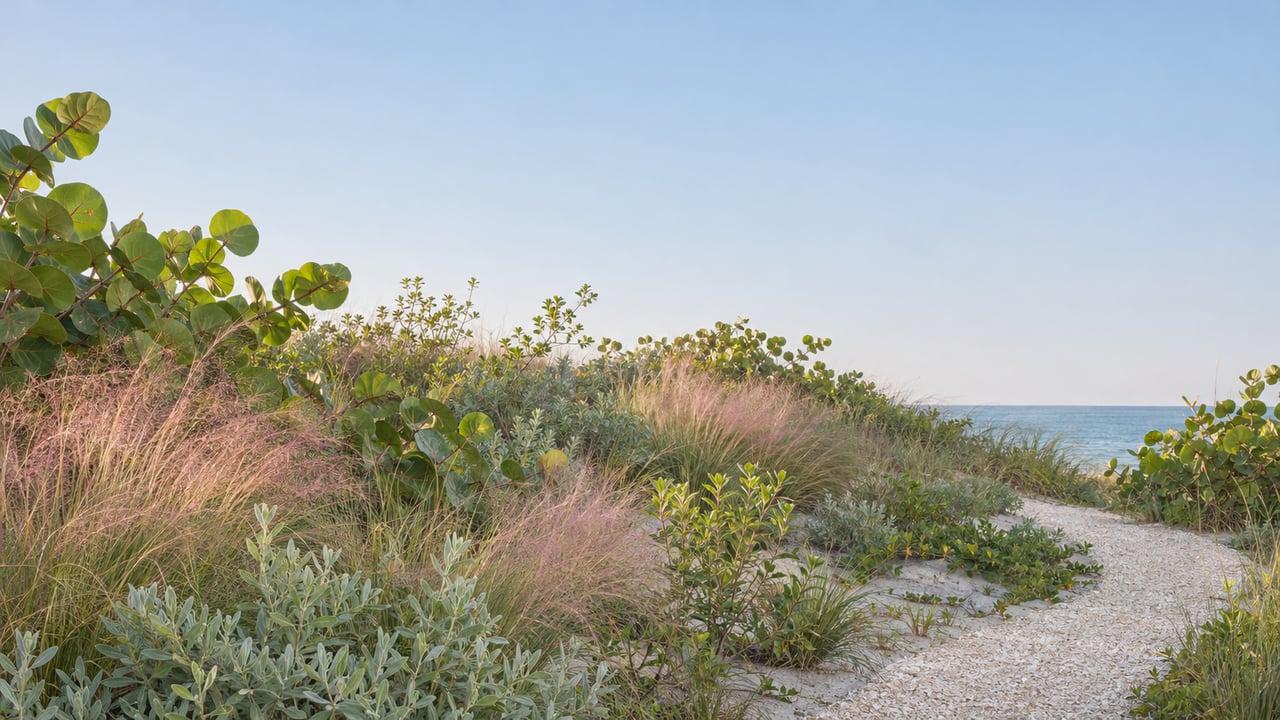
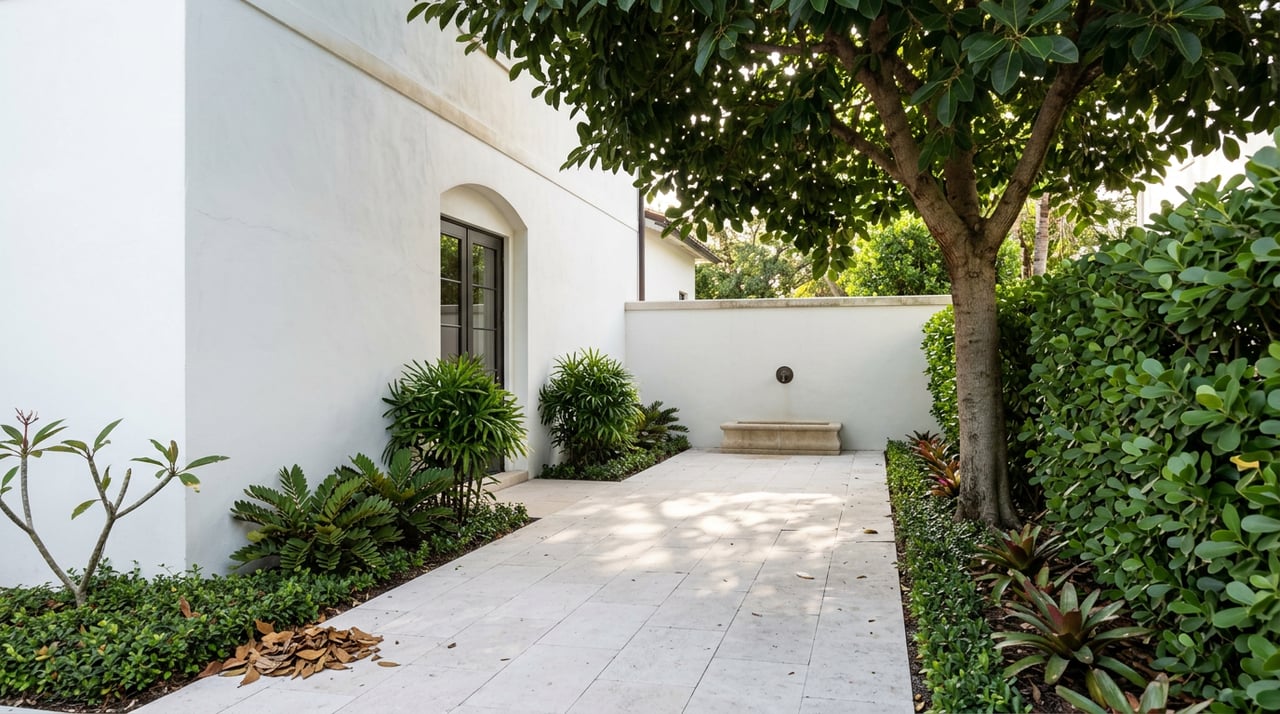
The lakeside condos give way to charming historic homes framed by tall hedges, white walls, and blooming bougainvillea, with the water flowing just feet from the path and old trees leaning over the shoreline beneath a thickening canopy.
That is the section that residents mean when they say the trail is different north of the bridge. Along the way, you pass Bethesda-by-the-Sea, a former church now a private residence filled with early 20th-century character, and the "Duck Nest," built in 1891 and considered Palm Beach's oldest surviving house. Neither is marked with the fanfare a tourist would expect. They are two of the oldest structures on the island, sitting in what looks like any other quiet block.
The second interruption comes just past Palm Beach Country Club. Past the Country Club it is about a mile to the Sailfish Club, where the trail circles the club alongside N. Lake Way, loops back lagoon-side to Reef Road, and ends at N. Lake Way. From that terminus, most residents keep going. The residential streets are calm, and the reward is at the tip of the island.
The rules and the summer-specific details
A few practicalities that matter more in July than in February:
- The trail is limited to a 10 mph speed limit, and no motorized or electric transport is allowed, which is worth knowing before someone shows up with an e-bike rental from the mainland.
- This is a mostly residential area, and the only restroom directly along the trail is at Bradley Park. Plan accordingly.
- Most of the trail is unshaded, so water, snacks, and sunscreen are not optional. The palms lean over the path in stretches, but the noon sun still finds you.
- During the summer months it is best to go in the mornings or at sunset and golden hour. This is the actual reason island residents shift to a 6:30 a.m. rhythm from June through September.
The stops that turn a walk into a routine
The reason a resident's walk takes 90 minutes instead of 45 has less to do with pace than with the pit stops that have accumulated along the way. The Publix on Sunset Avenue sits near the southern start of the north section of the trail, and Sprinkles Ice Cream and Sandwich Shop or Pizza Al Fresco can handle lunch. A smoothie at Celis Juice Bar inside The Royal Poinciana Plaza is a common pit stop for anyone heading north. A gourmet sandwich from Buccan's Sandwich Shop, eaten on the beach, is a common finish for anyone doing the full southbound leg back toward Worth Avenue.
There is also a quieter detour worth learning. Amy Woods, the author of Secret Palm Beach, recommends a stroll through Pan's Garden, where visitors can see thousands of native plants, the Frederick MacMonnies bronze Pan of Rohallion on the east side, and a fountain on the west side that incorporates a stone wall from the landmark estate Casa Apava. It is a short walk off Hibiscus Avenue and it is the best shaded ten minutes you can add to the middle of a summer morning.
Past the trail's end
For anyone willing to keep going after the pavement runs out, the north tip of the island is the reward the trail never advertises. The Sea Isles Estates Pier Park, open from 6:00 a.m. to 9:00 p.m., features a pier looking out at the waterway connecting the Intracoastal to the Atlantic Ocean. The public dock at the northern tip of the island gives you a brisk ocean breeze and a view of the Port of Palm Beach inlet and, across the water, Peanut Island. From there, the ride or walk back down N. Ocean Boulevard puts the Atlantic on one shoulder for about two miles before the traffic on North County Road picks up.
That circuit, from Peruvian Avenue to the pier and back down the ocean side, is roughly a 12-mile round trip. It is also the closest thing the island has to a public commons. Which is the quiet argument for why the Lake Trail matters in the first place. On an island where almost every waterfront view is behind a hedge, this is the one line of shoreline where the town actually meets itself.
Sell With Confidence
Understanding how residents actually live on the island, right down to which end of the Lake Trail has the working restroom, is the same discipline we bring to representing the estates that line it. When you are ready to have a discreet, results-driven conversation about your Palm Beach property, Chris Leavitt and Ashley McIntosh are ready to listen.