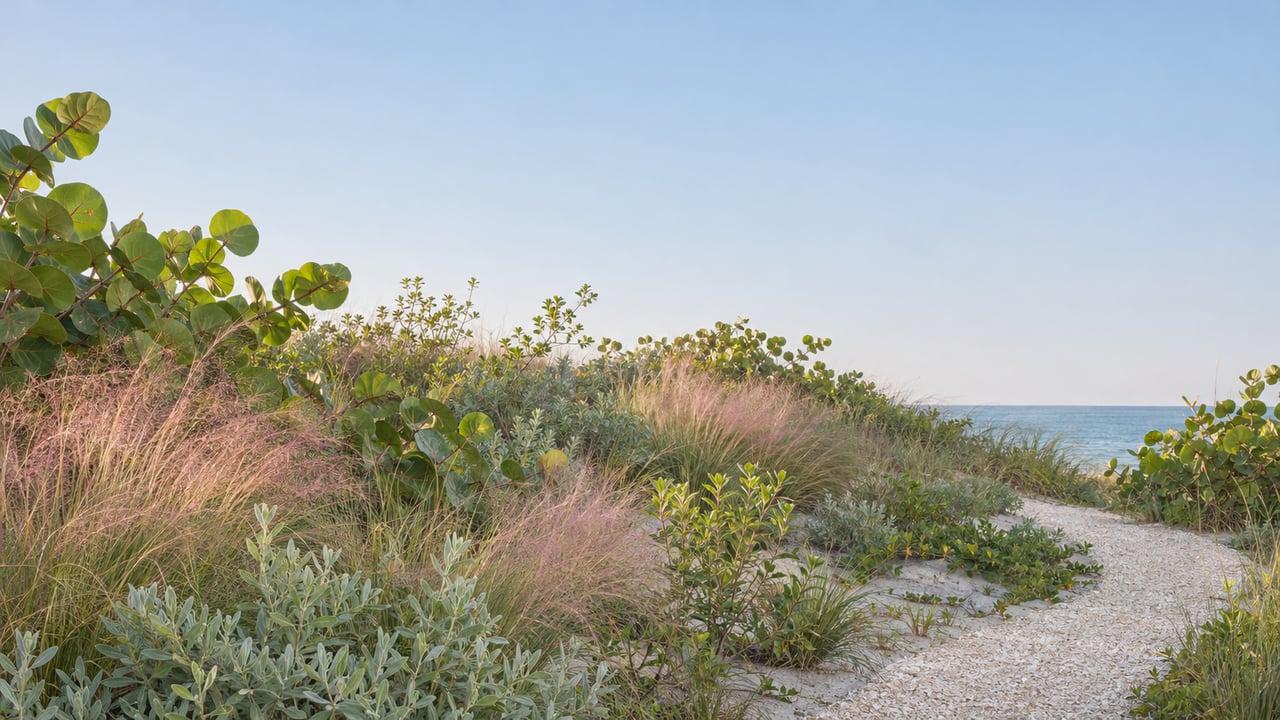
Walk the stretch of Midtown Beach between Chilean and Australian Avenues this month and the sand under your feet is different than it was in April. Back then, erosion had eaten the beach down to exposed rock, bad enough that the town moved the lifeguard tower off the sand entirely and onto the sidewalk because the drop-off had become dangerous. That tower sits back on real sand now. So do the joggers, the dog walkers, and, increasingly, rows of hotel loungers that weren't there a year ago.
Those three things are connected, and the connection is the actual story. The Town of Palm Beach just finished a $20 million project to rebuild this shoreline. It's about to start a second, longer one to replace the wall behind it. At three consecutive Town Council meetings, members have considered who can put chairs on the sand in between without reaching a decision. The discussion is also shaped by uncertainty about what this beach will look like in eighteen months.
What $20 Million and 600,000 Cubic Yards Bought Back
The Mid-Town Beach Renourishment Project began February 18, 2026, run by the U.S. Army Corps of Engineers with the town as local sponsor. The scope covered 3.4 miles of shoreline from Seminole Avenue on the near North End down to Banyan Road, the stretch that includes both Midtown's municipal beach and the private frontage of the Estate Section. Weather pushed the deadline back twice before crews finally wrapped on May 25.
By the time the dredge pulled out, the project had placed close to 600,000 cubic yards of sand on the beach, enough to fill roughly 182 Olympic-size swimming pools. The town's original estimate had been about 480,000 cubic yards. Coastal officials raised that number as the scope of the erosion became clearer during construction. It was a federally backed project, so the Army Corps covered most of the cost, with the town paying its share mainly for temporary easements on private beachfront needed to stage equipment.
The reason the project mattered isn't abstract. Before it started, sections of Midtown Beach had eroded enough to expose the rock mounds buried under the sand to protect the shoreline. That's what forced the lifeguard tower onto the sidewalk and, at one point, closed the beach outright for hazardous swimming conditions. The fix wasn't cosmetic. It was the difference between a beach people could safely use and one they couldn't.
The Wall Comes Next
The sand was always going to be the easier problem. The harder one sits behind it: a seawall built in the 1920s that has protected South Ocean Boulevard and the condominiums along it for a century. The current structure, sheet pile with a concrete cap, runs 2,715 feet from Royal Palm Way to Gulfstream Road. Town Engineer Patricia Strayer told the Shore Protection Board that construction on its replacement could start as early as January 2027 and take up to two years to finish.
Strayer's reasoning for the sequencing was direct. She told the Palm Beach Civic Association that the sand had to go down before the wall could go up, because the sand in front of the seawall is the first line of defense against surf damage during construction. The Palm Beach Civic Association also quoted her warning about what's at stake if the wall isn't replaced:
"If the seawall fails, everything behind it starts failing. The road fails, then the condos."
So the timeline, in order: erode, rebuild the sand, then spend up to two years rebuilding the wall behind it. Midtown Beach is in the middle of that sequence right now, in the calm stretch between the two projects. It's also the exact window in which the town has been trying to write permanent rules for who can set up commercial beach furniture on that sand.
In Between: Proposals for Twenty Chairs and Fifty
Police Chief Nicholas Caristo brought the chair issue to the council in July, telling members that at least five hotels were currently placing furniture on municipal beaches, Midtown included, and that the practice had grown more visible as hotels expanded beach service for guests. The Boca Raton Tribune reported that the council directed staff to draft a fee-based permit ordinance. In August, they considered it and sent it back for more detail. On September 8, they took it up a third time and deferred it again.
The revised proposal that came back in September would have created designated commercial zones at two locations only: Midtown Beach and the beach at Sunset Avenue in the near North End. Beaches at Phipps Ocean Park and Clark Avenue were dropped from consideration entirely, on space and location grounds. The standard allowance under discussion was 20 chairs and 10 umbrellas per permit. The Colony Hotel, which sits on a dry lot without direct ocean access and has long sent staff to set up service at the south end of Midtown Beach, asked for as many as 50 chairs and 25 umbrellas on certain holidays, citing its size and guest count.
| Standard permit under discussion | The Colony's request | |
|---|---|---|
| Chairs | 20 | Up to 50 |
| Umbrellas | 10 | Up to 25 |
| Basis | Flat allowance per permit | Holiday exception, cited property size |
The Boca Raton Tribune quoted Council Member Julie Araskog pushing back on the request:
"That's our beach. What happens to the public? It's just too many to me."
She also noted that the Colony is typically full during season. Two residents spoke against the broader concept. One raised concerns about hotel vehicles stopping near homes to load and unload furniture and guests. The other argued the town should rely on its existing rules rather than build a new permitting system at all. The Boca Raton Tribune quoted Mayor Danielle Moore saying the town needed tools to manage beach use:
"I think we all recognize there's something that we can do better in managing something on the beach, and we need some tools."
Why the Council Keeps Sending It Back
Here's the detail that explains why three meetings have produced no vote. During the September discussion, the prospect of the coming seawall project, and the beach closures it will likely require, led some council members to question whether it made sense to lock in a new commercial-use ordinance for a beach that's about to become a construction zone again. Nobody has determined how access to Midtown Beach will be phased once wall construction starts, which means nobody can say with confidence what a chair permit even governs a year from now.
That's the actual mechanism behind the delay. It isn't that the council can't agree on a number between 20 and 50. It's that setting any number assumes a stable beach to apply it to, and Midtown doesn't have one of those right now. It has a beach that was rebuilt about four months ago and is scheduled to be dug up again within the next year and a half. The council sent the ordinance back for restudy without settling on chairs or umbrellas, and in the meantime told staff to keep enforcing existing rules and address hotel loading and unloading as complaints come in.
What This Actually Means for a Walk on the Beach Right Now
If you're on Midtown Beach this season, a few things are true simultaneously. The sand is back to a walkable, swimmable state for the first time since early spring, the result of a roughly three-month federal project that most residents only noticed as a series of orange cones and a temporarily relocated lifeguard tower. Commercial chair setups, the Colony's included, are still operating under existing town rules while the new permit system remains stalled. And within the next several months, the conversation is likely to shift again once the seawall project gets a firm start date, because that will force the exact phasing questions the council keeps raising back onto the agenda.
None of this is unusual for a barrier island that has spent a century balancing public shoreline use with private commercial activity. What's unusual is how compressed the timeline has become this year. A resident who hasn't been following Town Hall closely could reasonably assume the sand project settled things. It didn't. It just cleared the way for the next round of discussion.
For those weighing whether now is the moment to buy on this stretch of the island, the pattern is worth knowing before an inspection turns up a seawall assessment or a beach-access easement question. The Leavitt McIntosh Team tracks these civic timelines the way it tracks comparable sales, because on Palm Beach the two are rarely unrelated. Sell with Confidence.